How Long Does It Take to Build a House in NZ? The Real Auckland Timeline
Last updated:
Quick answer: most Auckland new builds run 12 to 18 months from signed contract to handover. That is the range we programme to, and close to half of it is spent on design, consenting and sign-off rather than on site. The statutory clocks are short. It is the pauses between them that stretch a build.
Ask ten Auckland builders how long it takes to build a house and you will get ten answers, all of them measuring different things. Some are quoting the time from foundation pour to final coat of paint, which is the shortest and least useful number in the whole process. The question you actually need answered is how long until you get the keys, and that clock starts the day you commit to a design.
Here is the part most timeline articles skip. The Building Act and the Resource Management Act set fixed processing limits on councils, and those limits are genuinely short: 20 working days for a building consent, 20 working days for a non-notified resource consent, 20 working days for a code compliance certificate decision. Add them up and the regulatory portion of an Auckland build looks like about three months of council time. Almost nobody experiences it that way.
The reason is that every one of those clocks can be stopped. When Auckland Council asks you for more information, it pauses the statutory clock and does not restart it until the full response lands. That single mechanism is responsible for more slipped move-in dates than weather, material shortages and trade availability combined, and it is almost entirely within your control before you lodge.
We build across Auckland, from infill sites in Mt Albert and Te Atatu through to new sections in Hobsonville Point and Millwater, and the projects that finish on programme are almost always the ones that lodged a complete application the first time. Not the ones with the simplest design. Not the ones with the best weather run.
This piece sets out the whole calendar in order, with the statutory timeframes named and sourced, so you can see where your months actually go. Where a number comes from Auckland Council, Watercare or the Ministry of Business, Innovation and Employment, it is linked. Where it comes from how we programme our own jobs, it says so.
Want a realistic timeline? Sonder Architecture’s building consent timeframe estimator gives your statutory decision date and a realistic finish once typical delays are factored in.
The Four Clocks That Set Your Move-In Date
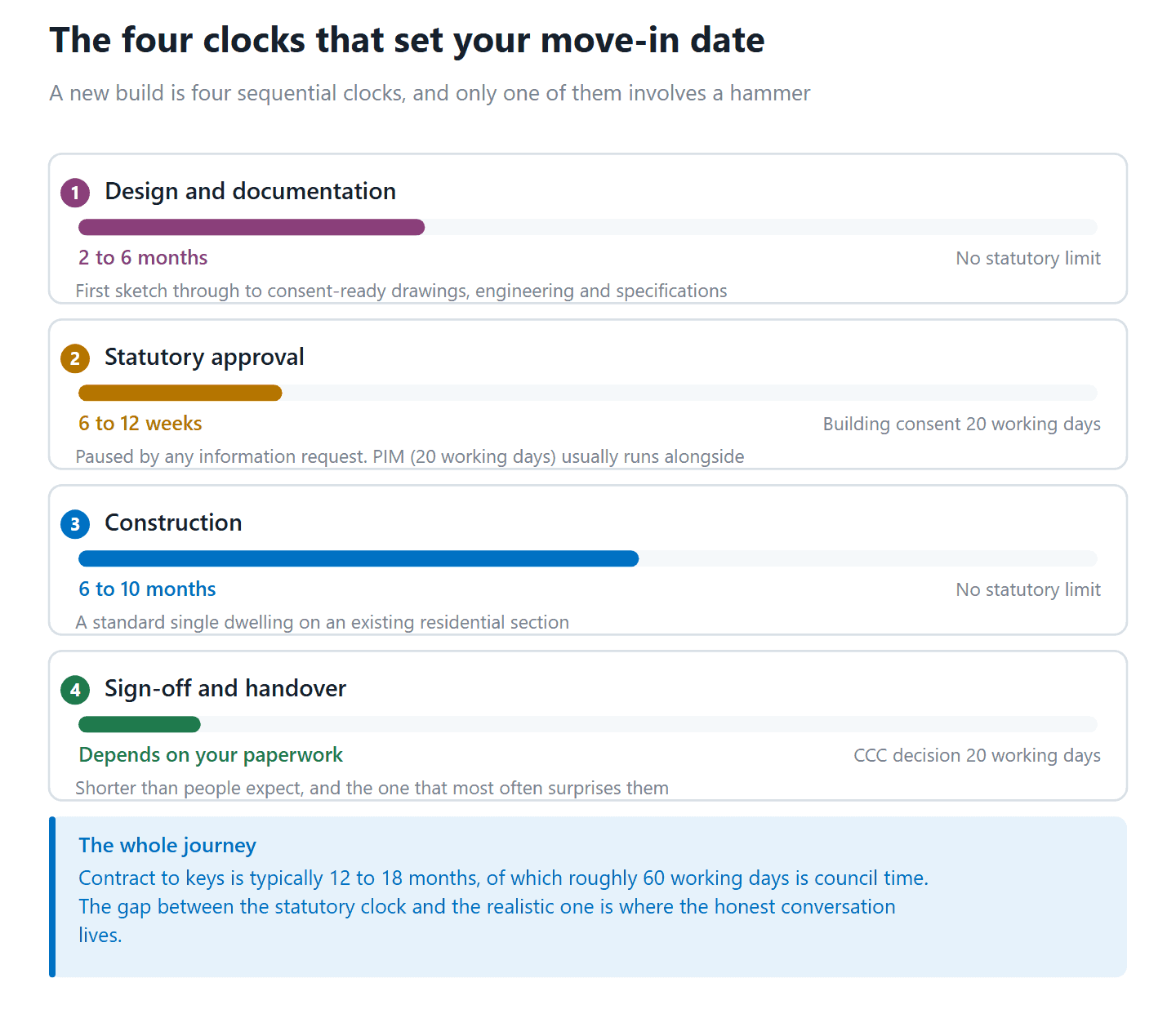
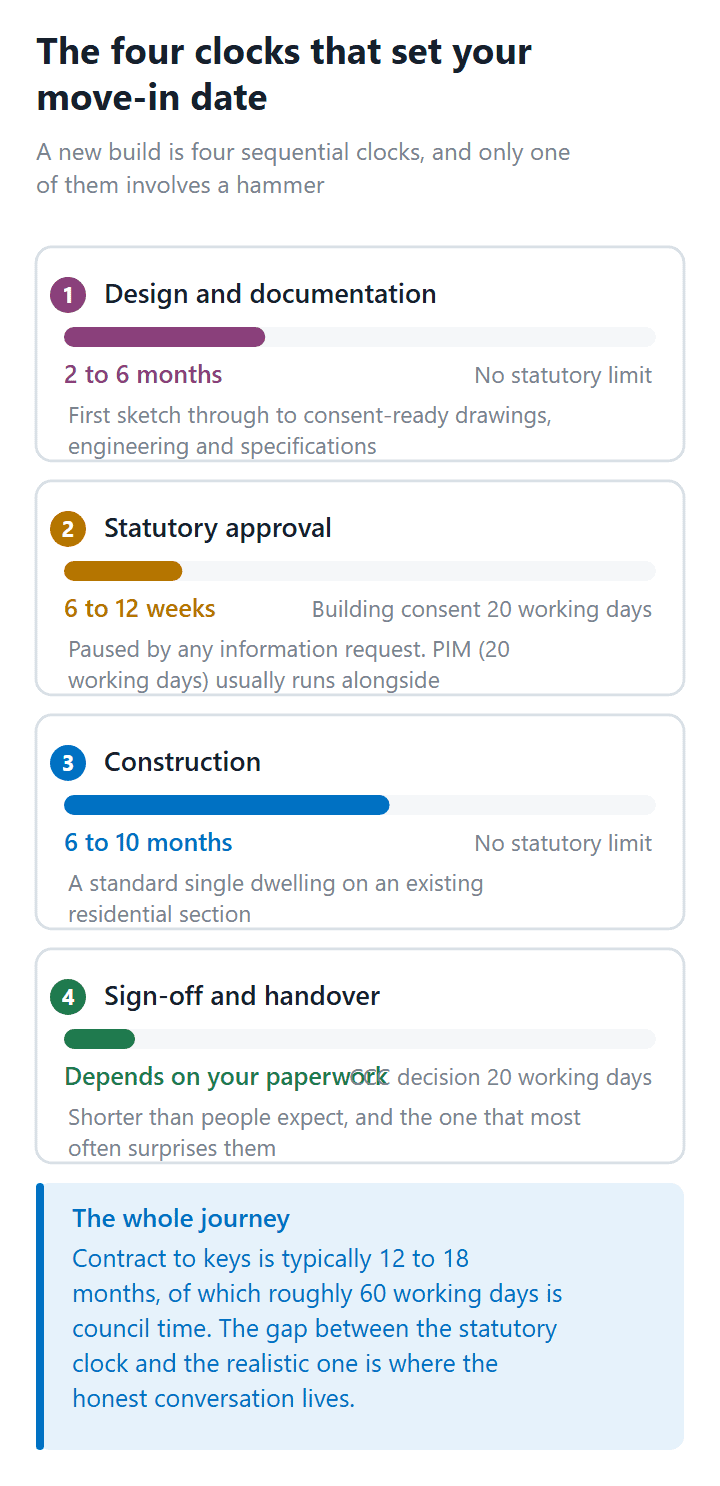
A new build is not one timeline. It is four sequential clocks, and only one of them involves a hammer. Understanding which clock you are on at any given moment is the difference between a client who feels informed and one who feels stonewalled.
Clock one is design and documentation, which runs from the first sketch through to a full set of consent-ready drawings, engineering and specifications. Clock two is statutory approval, where the council assesses what you have drawn. Clock three is construction. Clock four is sign-off and handover, which is shorter than people expect but is the one that most often surprises them.
What each phase typically takes on an Auckland build
The table below is how we programme a straightforward single-dwelling new build on an existing residential section, with the statutory limits shown separately from the realistic elapsed time. The gap between those two columns is where the honest conversation lives.
| Phase | Statutory clock (if any) | Realistic elapsed time |
|---|---|---|
| Design and documentation | None | 2 to 6 months, depending on how custom the design is |
| Resource consent (only if the design breaches a zone rule) | 20 working days, non-notified | Longer if the council requests further information |
| Project information memorandum (PIM) | 20 working days | Usually runs alongside the building consent |
| Building consent | 20 working days, paused by any information request | 6 to 12 weeks including responses and payment |
| Construction | None | 6 to 10 months for a standard single dwelling |
| Code compliance certificate decision | 20 working days from application | Depends entirely on your paperwork being complete |
| Contract to keys | Roughly 60 working days of council time | 12 to 18 months |
Two terms need defining before we go further, because they get used interchangeably and they are not the same thing. A resource consent is the council’s permission to use the land in a particular way, and you only need one if your design breaches a rule in the Auckland Unitary Plan, the single planning document that sets zoning and development rules across the region. A building consent is separate: it is the council’s approval of the construction work itself against the Building Code.
A well-designed house on a compliant section often needs no resource consent at all, which removes a whole phase from the calendar. That is one of the first things worth testing, because a design decision that saves 200mm of height in relation to boundary can save you two months and several thousand dollars.
🏠 Development tip: Before you fall in love with a design, get someone to run it against the zone rules for your specific site. A compliant scheme skips the resource consent phase entirely; a scheme that breaches one control by a small margin costs you a separate 20-working-day assessment.
The fourth clock, sign-off, is where owners most often lose weeks they did not budget for, because it depends on documents produced by other people: your electrician’s energy work certificate, engineering producer statements, and the records for any restricted building work (RBW, meaning the structural and weathertightness work that legally must be done or supervised by a Licensed Building Practitioner). If one of those is missing, the certificate waits.
“The council’s 20 working days is the one part of the programme we cannot speed up. Everything we can control sits either side of it, and that is where we spend our effort: a complete lodgement going in, and a complete document pack coming out at the end.”
— Superior Homes Team
If you want the stage-by-stage version rather than the summary, we set out where each inspection and sign-off sits in our build programme in more detail. The order rarely changes. The durations always do.
Before the Diggers Arrive: Design, Consent and the Clock That Stops
Roughly four to eight months of a typical Auckland build happens before anyone breaks ground, and this is the phase where a programme is either protected or quietly destroyed. It is also the phase owners find hardest to accept, because from the outside it looks like nothing is happening.
Design and documentation: the phase with no statutory limit
No law caps how long design takes, which is precisely why it needs the tightest management. A modified standard plan can reach consent-ready documentation in two to three months. A fully custom home on a difficult site, with structural engineering, geotechnical input and a specific weathertightness design, can take six.
Our architectural partner Sonder Architecture handles the design and consent-documentation lane for a lot of our clients, and their architectural design process is worth reading if you are trying to work out how much of your calendar the drawings will eat. Design decisions made late are the single most expensive kind of delay, because they reset documentation, re-trigger engineering, and in the worst case require a consent amendment mid-build.
What the council is actually allowed to take
Auckland Council has 20 working days to process a building consent application, and states plainly that if it needs more information, “the 20-working day statutory clock is paused until we receive your response”. The council is explicit that the statutory clock only counts the days it is actively processing. Every day your application sits with you is invisible to that number.
The response window matters as much as the request itself: Auckland Council gives you 20 working days from the date it first requests information to respond. If you do not, it sends two reminders across a three-month period, and an application that is never completed can be refused for non-compliance with the Building Code. A request for further information, usually shortened to RFI, is not a rejection. It is a stopped clock with your name on it.
The same mechanism applies on the planning side. Auckland Council assesses a non-notified resource consent over 20 working days, and a request for further information under section 92 of the Resource Management Act pauses that assessment until you respond. Notified applications, where affected parties get a say, run considerably longer and are a different conversation entirely.
The parallel approvals nobody warns you about
A building consent is not the only approval in flight during those weeks. A project information memorandum, or PIM, is the council’s summary of what it already knows about your site, including hazards, services and any special conditions attached to the land. It carries its own 20-working-day timeframe and usually runs alongside the consent application.
Fire and Emergency New Zealand reviews applicable applications within 10 working days, according to Auckland Council, which for most single dwellings is not a factor but becomes one on multi-unit work. Development contributions, the charges the council levies to fund infrastructure serving new development, are assessed in this window too and must be paid before the consent is issued.
Important: Consent requirements, restricted building work and Building Code compliance are decided case by case on your specific site. Nothing here replaces advice from Auckland Council or a Licensed Building Practitioner. Check the current position on the Auckland Council building consent process guide and confirm your own project with the council before you commit to a programme.
🏠 Development tip: Ask your builder or designer what their RFI rate has been on recent Auckland lodgements. A team that routinely gets a clean run has systems for it. A team that shrugs at the question is going to cost you a month.
One more date sits quietly at the end of this phase: once your building consent is issued, work must start within 12 months or the consent lapses under the Building Act. Auckland Council states it directly: “From the date your building consent was issued, you have 12 months to start work unless we have already agreed to a specified extended period of time.” If finance or a section settlement is going to run past that, you apply for an extension before the lapse date, not after.
On Site: What a Real Build Programme Looks Like Month by Month
Construction on a standard Auckland single dwelling runs about six to ten months, and unlike the consent phase, it is a programme you can watch progress. It is also the phase where small delays compound, because trades are booked in sequence and a week lost at framing is rarely a week lost in isolation.
The sequence, and where the pinch points sit
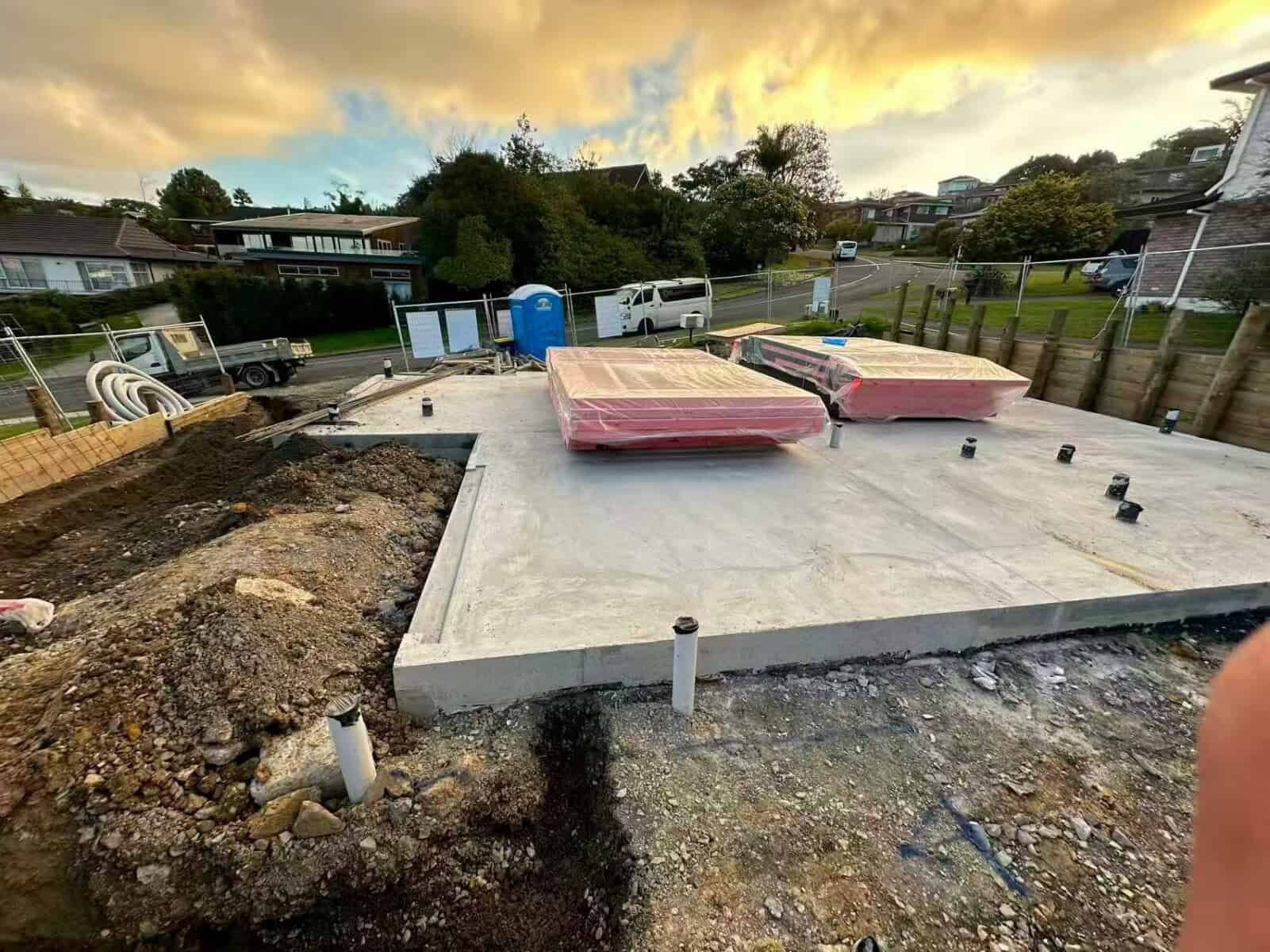
Site works and foundations typically take four to eight weeks on a flat Auckland section, and considerably longer on a sloping site in somewhere like Titirangi or Beach Haven where retaining and piling enter the picture. Clay soils across much of central and west Auckland drive foundation design, and a geotechnical report that arrives late holds up everything behind it.
Framing and roof usually run six to ten weeks, at which point the house becomes weathertight and the programme becomes far less exposed to rain. Getting to closed-in before winter is the single most valuable scheduling decision on an Auckland build, because June through August delivers the rain days that stop exterior work and slow concrete and cladding.
Interior fit-out, from linings through to kitchen, joinery and final finishes, is the longest single stretch at roughly three to five months, and it is the phase most sensitive to product lead times. Imported joinery, specific tile runs and custom cabinetry all carry their own procurement clocks. Our group manufactures cabinetry through Little Giant Interiors, which takes one common lead-time risk out of the programme, though it does not remove the need to make selections early.
Council inspections: shorter than you think, if you book them properly
Auckland Council must complete 80 per cent of building inspection requests within three working days, a performance requirement under the Building (Accreditation of Building Consent Authorities) Regulations 2006. That is a far better service level than most people assume, and it means inspections are rarely the true cause of a stalled site.
The booking rules are where sites lose days: an inspection must be booked before 1pm to secure the next day, and cancelling after midday the day before forfeits the full fee. On a build with a dozen or more inspections, a site manager who books late twice a month has quietly added a fortnight to the programme by the end of the job.
🏠 Development tip: Failed inspections are the expensive kind of delay, because they stop the trade behind them as well. Have the LBP records, product documentation and any engineering sign-offs on site before the inspector arrives, not after they ask.
The connection that runs on its own timetable
Watercare, Auckland’s council-owned water and wastewater network provider, runs a separate application process from the council’s, and it is one of the most commonly forgotten items on a new-build programme. For a residential connection, Watercare states it will send an invoice within 10 days of receiving your application, and that approximately 15 working days after your payment date it will install the water meter or email the approved wastewater connection plans.
Traffic management requirements can push that out further, which matters on arterial roads and in denser suburbs like Onehunga, New Lynn and Panmure. Lodging the connection application early, while the consent is still being processed, costs nothing and removes a genuine four-to-six-week risk from the back end of the build.
If you are weighing up a section and want a realistic programme before you commit, that is exactly the conversation to have early rather than late. Book a free consultation and bring the site address; most of the timeline questions are answerable from the zone, the soil and the services.
Sign-Off and Handover: The Two Deadlines at the End of a Build
The last phase of a new build is short on paper and unpredictable in practice, and it hinges on a document called the code compliance certificate. The CCC is what Auckland Council issues when it is satisfied the finished building work complies with the building consent. Without it, your lender, your insurer and any future buyer all have a problem.
Two separate clocks, frequently confused
The Ministry of Business, Innovation and Employment states that “the council has 20 working days from the date of your application to decide whether to issue a code compliance certificate”, and that you must apply “as soon as practical after completing the building work”. That is clock one, and it behaves exactly like the consent clock: if the council needs more information, the process goes on hold until it arrives.
Clock two is longer and less well known. Auckland Council must decide whether to approve or refuse a CCC within two years of the building consent being granted. On a build that runs long, or where a section settlement delayed the start, that two-year mark can arrive uncomfortably close to completion, and it is a date worth having on the programme from day one.
What actually holds up a certificate
In our experience the CCC almost never waits on the building work. It waits on paperwork produced by other trades. The usual list is energy work certificates for electrical and gas work, producer statements from engineers, memoranda from the Licensed Building Practitioners who carried out or supervised restricted building work, and manufacturer documentation for specified products.
Collecting those documents progressively through the build, rather than chasing them in the final fortnight, is the difference between a three-week sign-off and a three-month one. It is unglamorous project-management work and it is one of the clearest arguments for having a single party accountable for the whole build rather than coordinating trades yourself.
Practical completion and handover usually sit a week or two before the CCC is issued, which means you can often move in while the certificate is still being processed, subject to your lender and insurer being comfortable. That is a conversation to have with them early rather than assuming.
Important: Whether you can occupy a home before the code compliance certificate is issued depends on your consent conditions, your insurance and your lender. Confirm the position for your build with Auckland Council and read the Ministry of Business, Innovation and Employment guidance on getting the build signed off.
🏠 Development tip: Ask for the CCC document checklist at the start of the build, not the end. Every item on it belongs to a trade who will be long gone by the time you need it.
We take on the whole build from consent through to handover partly because this phase is so much easier when one party has been collecting the documents the entire way through. Fragmented builds are where certificates go missing.
What Could Change: The Building Amendment Bill and Faster Consenting
The timeframes above are current law, but a significant reform is working its way through Parliament and would change several of them. The Building Amendment Bill was introduced and passed its first reading on 2 July 2026. It is now before a select committee and is not law, so nothing in it applies to a build starting today.
Two proposals in the Bill would directly shorten a new-build programme. The Ministry of Business, Innovation and Employment describes a fast-track pathway with “decisions by Building Consent Authorities being made in 10 working days for eligible solar equipped and sustainable homes”, and a reduction in project information memorandum processing “from 20 to 10 working days”.
Eligibility for the fast track is tied to sustainability criteria including energy efficiency, reduced carbon footprint, improved water efficiency and increased climate resilience, alongside solar electricity systems. If it passes in that form, specifying solar at design stage becomes a scheduling decision as much as an environmental one, which is a genuinely new consideration for anyone designing now for a build starting in 2027.
The Bill also proposes mandatory home warranties, proportionate liability replacing the current joint and several regime, and mandatory professional indemnity insurance for design professionals. None of those affect the calendar directly, though they change the risk picture. We covered what protects a new build under the current law in our piece on builders guarantees in NZ.
Treat all of this as a signal, not a plan. Select committee stages change bills, and commencement dates for building reform routinely land later than the sector expects.
So How Long Will Your Build Actually Take?
Twelve to eighteen months from signed contract to keys is the honest answer for a standard Auckland new build, and the variance inside that range is mostly decided before construction starts. A modified standard plan on a flat, serviced, compliant section at the fast end. A custom design on a sloping site needing resource consent, engineering and a Watercare connection at the slow end.
The three levers that actually move the date are the completeness of your consent application, how early you lock your selections, and whether you get closed in before an Auckland winter. Weather and material supply get the blame far more often than they deserve.
If someone quotes you a build time without asking about your zone, your soil, your services and your design status, they are quoting the construction phase and calling it the programme. Ask which clock they are measuring.
➡ Book a free consultation with Superior Homes
➡ See our completed Auckland projects
➡ Learn more about new home builds with Superior Homes
How long does it take to build a house in NZ?
We programme most Auckland new builds at 12 to 18 months from signed contract to handover. Roughly four to eight months of that is design, documentation and consenting before construction starts, and six to ten months is the build itself. The range depends mostly on how custom the design is, whether the site needs resource consent, and site conditions such as slope and soil type. Council processing is a smaller portion of the calendar than most people assume.
How long does Auckland Council take to approve a building consent?
Auckland Council has 20 working days to process a building consent application. That clock is paused if the council requests further information, and it only counts days the council is actively processing. In practice most applicants should allow six to twelve weeks from lodgement to an issued consent, which covers the assessment, any information request, and paying fees and development contributions before the consent is issued.
What is a request for further information and how much delay does it cause?
A request for further information, or RFI, is the council asking for missing or unclear detail in your application. Auckland Council stops the processing clock until all requested information is provided, and gives you 20 working days from the first request to respond. If you do not respond, the council sends two reminders over a three-month period and the application can eventually be refused. A clean, complete lodgement is the single best defence.
Do I need a resource consent to build a new house in Auckland?
Only if your design breaches a rule in the Auckland Unitary Plan, which is the planning document setting zoning and development rules across the region. Common triggers include height in relation to boundary, site coverage, and overlays such as flooding or heritage. A fully compliant design on a standard residential section often needs no resource consent at all, which removes a 20-working-day assessment from the programme. Confirm your own site with Auckland Council.
How long does the construction phase take on an Auckland new build?
A standard single dwelling generally runs six to ten months on site. Site works and foundations take roughly four to eight weeks, framing and roof six to ten weeks, and interior fit-out three to five months. Sloping sites needing retaining or piling, and homes with long-lead imported joinery, sit at the upper end. Getting the house closed in before winter is the most valuable scheduling decision on an Auckland build.
How long do council building inspections take to book?
Auckland Council must complete 80 per cent of building inspection requests within three working days, a requirement under the Building (Accreditation of Building Consent Authorities) Regulations 2006. Inspections must be booked before 1pm to secure the next day, and cancelling after midday the day before forfeits the full fee. Inspections are rarely the real cause of a stalled site; late bookings and failed inspections are.
How long does a Watercare connection take for a new build?
Watercare states it will send an invoice within 10 days of receiving your residential connection application, and that approximately 15 working days after your payment date it will install the water meter or email the approved wastewater connection plans. Traffic management requirements can extend that. Lodging the application while your building consent is still being processed removes a real four-to-six-week risk from the end of the build.
How long do I have to start building after my consent is issued?
Auckland Council states you have 12 months from the date your building consent was issued to start work, unless the council has already agreed to an extended period. If work does not start in time the consent lapses and you need a new one. An extension must be requested before the lapse date, not after. If finance approval or a section settlement might push past 12 months, raise it with the council early.
How long does a code compliance certificate take?
The Ministry of Business, Innovation and Employment states the council has 20 working days from the date of your application to decide whether to issue a code compliance certificate, and that you should apply as soon as practical after the building work is complete. Separately, Auckland Council must decide whether to approve or refuse a CCC within two years of the building consent being granted. Missing paperwork, not building work, is the usual cause of delay.
Will building consents get faster in New Zealand?
Possibly. The Building Amendment Bill passed its first reading on 2 July 2026 and is before a select committee, so it is not law. The Ministry of Business, Innovation and Employment says it proposes a 10-working-day consent decision for eligible solar equipped and sustainable homes, and cutting project information memorandum processing from 20 to 10 working days. Nothing in the Bill applies to a build starting today, and commencement dates for building reform often move.
Free Guide: Avoid Costly Mistakes When Building or Developing
Download our free guide — everything you need to know before you build or develop in Auckland, put together by the Superior Homes team.
References
- Auckland Council — How we assess your building consent application
- Auckland Council — Requests for further information, building consents
- Auckland Council — Building consent process 10-step guide
- Auckland Council — Resource consent process 10-step guide
- Auckland Council — Extension of time to commence or complete building work
- Auckland Council — Book or cancel a building inspection
- Building Performance, MBIE — Get the build signed off
- Building Performance, MBIE — Building Amendment Bill introduced to Parliament
- Watercare — Apply for a residential connection