Property Development Finance in Auckland: How Developers Actually Fund a Build
Last updated:
Quick answer: Property development finance in Auckland funds a build in two stages — a land facility to buy the site, then a construction facility drawn down in stages as the work is completed. Lenders size it against total development cost (usually 70–80%) or gross realisation value (65–75%), and most want a fixed-price build contract, a credible feasibility, and an exit plan before they commit.
In July 2026 the Reserve Bank lifted the Official Cash Rate (the wholesale rate that sets the floor under every business and mortgage rate in the country) to 2.50%, and signalled more rises to come. For anyone funding a townhouse or subdivision project, that single number changes the maths. Interest is one of the largest line items in a development budget, and it runs the whole time your money is tied up in an unsold building.
So the way you structure the finance is no longer a back-office detail. It decides whether a project clears its margin or grinds it away in holding costs.
Here is the part most guides skip. Development finance is not a bigger home loan. A residential mortgage lands in your account as a lump sum against a house that already exists. Development finance is released in pieces, against work that does not exist yet, on the strength of what the finished dwellings will be worth. The lender is underwriting a forecast, not a valuation. That changes what they ask for, how the money flows, and what happens if the build slips.
We build townhouses and manage subdivision projects across Auckland, so we sit on the delivery side of that arrangement every week. This is how development finance actually works once the build starts — the drawdown mechanics, the presale question, the costs that quietly eat a feasibility, and how to line the funding up with the programme so the two do not fight each other.
How Property Development Finance Actually Works
Development finance is short-term funding built in two parts: a land facility to secure the site, then a construction facility that pays for the build in staged instalments. Unlike a standard mortgage, the money is not advanced all at once. It is released as each stage of work is finished and signed off.
The two facilities: land, then construction
Most projects start with land funding to buy or settle the site. Depending on timing and how the deal is set up, that land debt often rolls into the construction facility once consent is in hand and the build is ready to start. The construction facility then covers build costs, professional fees, council charges, finance costs, and a contingency.
The construction money is approved on the strength of three things: completed designs, a fixed-price build contract, and a confirmed feasibility. A lender wants to see that the number you have quoted to build is the number you will actually pay. That is why a genuine fixed-price contract from an established builder carries weight at the finance table — it removes the lender’s single biggest fear, which is a cost blowout halfway up the build.
🏠 Development tip: Get your fixed-price build contract and a realistic feasibility locked before you approach a lender, not after. Turning up with firm numbers shortens approval and usually improves the terms you are offered.
Staged drawdowns and the QS report
Here is the mechanic that catches first-time developers. Construction funds come out in drawdowns — chunks released at set points in the build, not on demand. Before each drawdown, the lender sends a quantity surveyor (a QS, the person who measures and prices completed building work) to confirm the stage is genuinely finished and that the remaining budget still covers the remaining work.
Miss a milestone, or let the programme drift, and the next drawdown stalls. That is when developers get caught paying subcontractors out of their own pocket while they wait. The build programme and the drawdown schedule have to be written to match each other, which is exactly where a builder who has run this before earns their keep.
Project Highlight
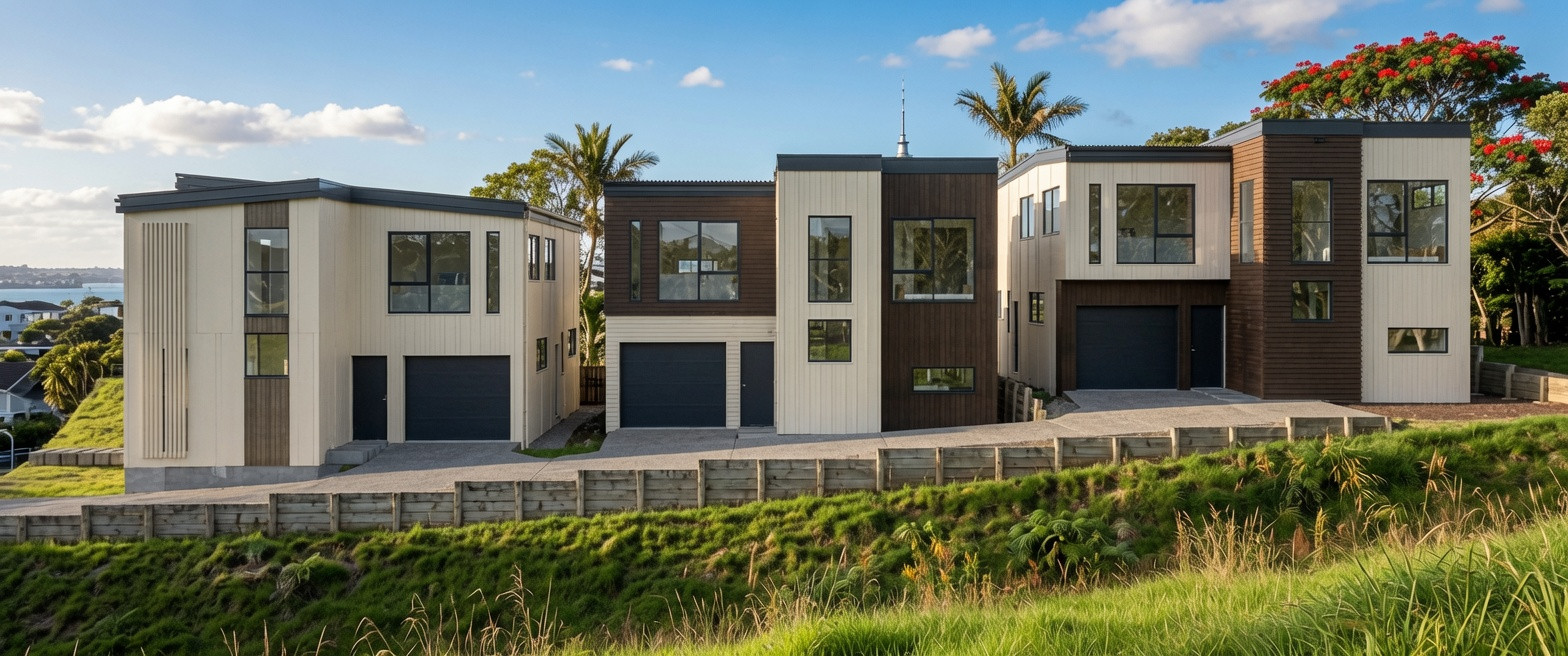
This client of ours in Mairangi Bay, North shore, Auckland, had a large home that was no longer needed, so he decided to subdivide into three townhouses. The rendering at the beginning of this blog shows the design by our design team. The picture below shows the townhouses built in stages.
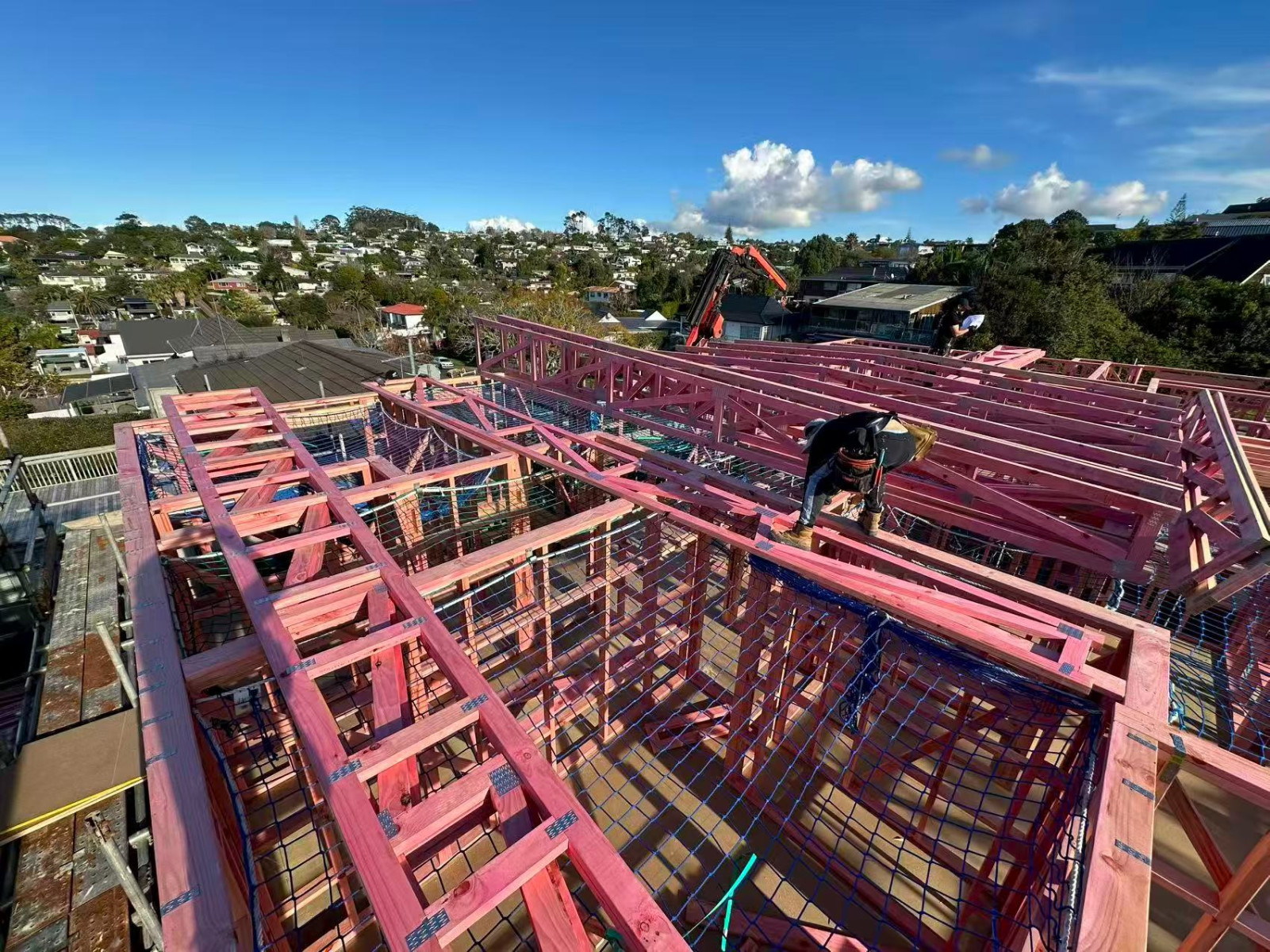
Development finance moves in two stages — a land facility to secure the site, then a construction facility that funds the build itself.
GRV versus TDC: the two ways a lender sizes your loan
Lenders work off one of two ceilings, and it pays to know which one you are being measured against.
| Lending basis | Typical ceiling | What it means for you |
|---|---|---|
| Total development cost (TDC) — land + build + fees + interest + contingency | 70–80% of total cost | Most common option. You fund the remaining 20–30% as equity. |
| Gross realisation value (GRV) — the projected end value of the finished dwellings | 65–75% of end value | Can cover more of the project, and presales are often not required. |
TDC lending is the workhorse for small Auckland developments. GRV lending stretches further because it is measured against what the project will sell for rather than what it costs, though lenders stress-test that end-value figure hard before they rely on it. Figures for both are published by NZ development finance specialists and confirmed with your lender case by case.
One point worth clearing up early. The Reserve Bank’s loan-to-value (LVR) and debt-to-income (DTI) caps, which limit how much a bank can lend against a home relative to its value or your income, are aimed at residential mortgage lending. A genuine multi-unit development is usually business lending that sits outside those caps. And where a build does touch residential mortgage rules, new builds are currently exempt from both LVR and DTI limits, a deliberate government setting to encourage supply.
What Lenders Want Before They Say Yes
A development lender is underwriting a forecast, so they front-load their risk checks: fixed-price contract, credible feasibility, your equity, an exit plan, and, for larger projects, presales. Get these lined up and approval is fast. Turn up missing one and you will wait, or pay more for the money.
Your equity and the deposit
On a TDC basis you are usually funding 20–30% of total project cost yourself, whether that is cash, equity already sitting in the land, or both. The land you already own often does a lot of this work. If you bought a site years ago and it has risen in value, that lift can count as your contribution rather than fresh cash out of the bank.
🏠 Development tip: Ask your lender or mortgage adviser whether the equity in your existing section can serve as your contribution before you assume you need cash. On infill sites in suburbs like Mt Albert or Papatoetoe, the land value alone often covers most of the developer’s share.
Presales: when you need them and when you don’t
Presales — signing buyers to unconditional contracts before the build finishes — are the question that trips up new developers. Some lenders require a level of qualifying presales before they will fully advance construction funding, because a signed sale contract de-risks the exit. Others will fund with no presales at all, depending on the project and your track record.
The trade-off is real. Presales unlock better terms and cheaper money, but you lock in a sale price today for a dwelling that settles in a year, so you carry the risk of the market moving up without you. No-presale funding keeps your upside but costs more and leans harder on the lender’s confidence in your numbers. There is no single right answer — it turns on your risk appetite, the project size, and which lender you are talking to.
“The developers who get the cleanest finance terms are rarely the ones with the biggest deposit. They are the ones who turn up with a fixed-price contract, a feasibility that survives a stress-test, and a builder the lender has seen deliver before. Certainty is what gets priced, not optimism.”
— Superior Homes Team
The exit plan the lender is really buying
Every development facility hinges on a credible exit, the plan for how the debt gets repaid. That is usually selling the finished dwellings, but it can be refinancing them into long-term investment lending and holding, or a staged sell-down. A lender approves the project on the exit as much as the build, so a vague “we’ll sell them when they’re done” is weaker than a costed sales plan with realistic end values and a timeline. This is where the delivery track record of your build partner and a portfolio of completed Auckland projects does quiet work in the background — it tells the lender the forecast has a good chance of becoming real.
If you are still at the “is this site even worth developing” stage, the feasibility comes first. A planning-side feasibility assessment from our architecture partner, Sonder Architecture, confirms what the site can yield under the current rules before you spend a dollar on finance applications. There is no point structuring a loan around three dwellings if the site only supports two.
The Costs That Quietly Eat Your Feasibility
The finance headline rate is the cost developers watch. The ones that actually sink margins are interest running across a slow build, council development contributions, GST timing, and tax on the profit. None of them are hidden. They just get underestimated.
Important: This article is general information, not financial, tax, or legal advice. Development lending terms, GST treatment, and income tax on a project depend entirely on your circumstances and structure. Confirm the numbers with a licensed financial adviser or mortgage adviser, and your accountant, before you commit — and refer any consent or building-compliance questions to Auckland Council or a Licensed Building Practitioner. Contribution figures cited here come from the Auckland Council Development Contributions Policy 2025.
Holding costs and interest during the build
Development finance interest is charged on the balance drawn, and it accrues every week the project is unfinished and unsold. With the OCR at 2.50% and rising through 2026, a build that runs three months over schedule does not just cost you three months of trades. It costs three extra months of interest on a large drawn balance, plus rates, insurance, and any holding costs on the land. This is the single strongest argument for a builder who hits the programme — every week saved is a week of holding cost you never pay.
Development contributions
Development contributions are the charges a council levies on new dwellings to help fund the infrastructure that serves them, such as roads, water, and parks. Under the Auckland Council Development Contributions Policy 2025, in effect from 1 July 2025, these start from around $20,000 per household unit equivalent across most of Auckland, and average roughly $48,000 in the council’s Investment Priority Areas — the growth zones including the Inner Northwest, Drury, Māngere, Mount Roskill, and Tāmaki. Charges rise 2% a year, applied to invoices issued from 1 July 2026.
Multiply that across a three or four-unit development and it is a five-figure to six-figure line that has to sit inside your feasibility from day one, not surface as a shock when the consent is granted.
| Cost line | Who charges it | When it hits |
|---|---|---|
| Interest on drawn funds | Your lender | Weekly, across the whole build |
| Development contributions | Auckland Council | At consent / before CCC |
| QS report fees | Lender’s quantity surveyor | At each drawdown |
| GST on the sale | Inland Revenue | On settlement of each dwelling |
| Contingency | You — build it in | Whenever something goes sideways |
GST and income tax on the profit
Two tax points catch developers off guard, and both belong in the feasibility before you borrow. First, GST. Building dwellings to sell is a taxable activity, so once your turnover passes $60,000 you must register for GST. The upside is that you reclaim the GST on your development costs; the discipline is that you charge and hand over GST on each sale. For that reason, developer build costs are usually quoted GST-exclusive (you claim it back), whereas an owner-occupier sees the GST-inclusive price. Confirm the treatment with your accountant, because property GST is genuinely fiddly.
Second, income tax. According to Inland Revenue, if you buy and develop property as part of a development business, the profit on sale is taxable income no matter how long you hold it. There is no tax-free window for a trading developer. That tax bill is not a rounding error against your margin, so it belongs in the feasibility, not in a surprise conversation with your accountant after settlement.
Structuring Finance Around the Build Programme
The developers who protect their margin treat the finance and the build as one plan, not two. The drawdown schedule, the programme, the presale timing, and the sell-down all have to move together. When they don’t, holding costs are where the damage shows up.
Matching drawdowns to build stages
Picture a three-townhouse site in Henderson, a Mixed Housing Urban zone with room to build up. The finance is drawn in stages (foundations, closed-in, fit-out, completion), and each stage releases only once the QS confirms the work is done. If the build hits those stages on the programmed dates, the money flows and the interest clock stays as short as it can be. If framing runs three weeks late because a subcontractor over-committed elsewhere, that drawdown waits, and you are covering costs in the gap.
That is the core reason we run projects with the funding schedule mapped against the build programme from the start. It is also how each build stage lines up with a lender’s drawdown release in practice — the two documents are written to talk to each other, so a completed milestone triggers the next tranche without a scramble.
🏠 Development tip: Ask your builder to give you a programme with the same stage names as your lender’s drawdown schedule. When the two match line for line, QS sign-offs and fund releases stop being a source of delay.
Presale timing and the sell-down
If your facility needs presales, the marketing has to start early enough that the contracts are signed before the drawdown that depends on them. Leaving presales until the build is nearly finished can mean the construction facility is capped right when you need it most. On a staged sell-down, the order in which units settle also affects how fast you repay the debt and stop the interest — a detail worth planning, not leaving to chance.
Where a single delivery partner changes the numbers
When design, consent management, and construction sit with one team, the handovers that usually cost weeks (architect to builder, builder back to council) get shorter. Fewer gaps in the programme means fewer weeks of interest on drawn funds. That is the practical value of an integrated delivery model, and it is the thread running through the full development service we deliver in-house for Auckland owners and investors. If you want to see how the cost side stacks up before the finance conversation, our breakdown of what subdivision actually costs in Auckland covers the numbers that feed straight into a feasibility.
Development finance is not the scary part of a project. Underestimating the costs that ride alongside it is. Get the feasibility honest, structure the drawdowns around a build programme you can trust, and the finance does its job quietly in the background — which is exactly where it should be.
➡ Book a free consultation with Superior Homes
➡ See our completed Auckland projects
➡ Learn more about developing with Superior Homes
What is property development finance in New Zealand?
Property development finance is short-term funding used to buy a site and build a development, usually split into a land facility and a construction facility. Unlike a home loan, it is released in staged drawdowns as work is completed, and it is sized against the total development cost or the projected end value of the finished dwellings rather than an existing valuation.
How much deposit or equity do I need for a development loan?
On a total development cost basis, lenders typically fund 70–80% of the project, so you contribute the remaining 20–30% as equity. That equity can be cash or the value already sitting in land you own. On gross realisation value lending, the loan is measured against end value (usually 65–75%) and can cover more of the project. Confirm exact requirements with your lender or mortgage adviser.
What is the difference between GRV and TDC lending?
TDC (total development cost) lending is measured against what the project costs to complete (land, build, fees, interest, and contingency), usually 70–80%. GRV (gross realisation value) lending is measured against what the finished dwellings will sell for, usually 65–75%. GRV can stretch further and often needs no presales, but lenders stress-test the end-value figure carefully before relying on it.
Do I need presales to get development finance?
Not always. Some lenders require a level of qualifying presales (buyers signed to unconditional contracts) before fully advancing construction funding, because a signed sale de-risks the exit. Others will fund with no presales, depending on the project size and your track record. Presales usually unlock cheaper terms but lock in a sale price early, so it is a trade-off between cost of money and market upside.
How do staged drawdowns work?
Construction funds are released in tranches at set points in the build (commonly foundations, closed-in, fit-out, and completion) rather than as a lump sum. Before each drawdown, the lender's quantity surveyor inspects the site to confirm the stage is genuinely finished and that the remaining budget still covers the remaining work. Keeping the build on programme keeps the drawdowns flowing.
How much are development contributions in Auckland?
Under the Auckland Council Development Contributions Policy 2025, in effect from 1 July 2025, contributions start from around $20,000 per household unit equivalent across most of Auckland and average roughly $48,000 in the council's Investment Priority Areas such as the Inner Northwest, Drury, Māngere, Mount Roskill, and Tāmaki. Charges increase 2% a year, applied to invoices issued from 1 July 2026. Always check the current figure for your specific site with the council.
Do LVR and DTI rules apply to development finance?
The Reserve Bank's LVR and DTI caps target residential mortgage lending. A genuine multi-unit development is usually business lending that sits outside those caps. Where a build does fall under residential mortgage rules, new builds are currently exempt from both LVR and DTI limits, a deliberate government setting to support housing supply. Your lender or mortgage adviser can confirm which rules apply to your structure.
Do I have to pay GST as a property developer?
Building dwellings to sell is a taxable activity, so once your turnover passes $60,000 you must register for GST. You then charge GST on each sale but can reclaim the GST on your development costs. Because of this, developer build costs are usually quoted GST-exclusive. Property GST is complex and situation-specific, so confirm the treatment with your accountant before you finalise a feasibility.
Is profit from a property development taxable?
Yes. According to Inland Revenue, if you buy and develop property as part of a development business, the profit on sale is taxable income regardless of how long you hold it — there is no tax-free window for a trading developer. That tax liability should sit in your feasibility from the start. Speak to your accountant about how it applies to your structure.
How does the OCR affect my development project?
The Official Cash Rate sets the floor under lending rates. In July 2026 the Reserve Bank lifted it to 2.50% and signalled further rises. Because development interest accrues on the drawn balance every week until the project sells, a higher OCR raises your holding costs and makes hitting the build programme more valuable — every week saved is a week of interest you never pay. Build your feasibility with room for rate movement.
Free Guide: Avoid Costly Mistakes When Building or Developing
Download our free guide — everything you need to know before you build or develop in Auckland, put together by the Superior Homes team.
References
- Reserve Bank of New Zealand — OCR increased to 2.50% (July 2026)
- Reserve Bank of New Zealand — Loan-to-value ratio restrictions and new-build exemptions
- Auckland Council — Development Contributions Policy 2025
- Inland Revenue — Property dealers, developers and builders
- Inland Revenue — Registering for GST
- ASAP Finance — How does property development finance work?